
- I know, I’m late.
- I finally came back to finish this post and I hadn’t saved the draft. I had to start over. So there may be errors.
- The headline is misleading. There’s obviously a lot of enthusiasm for film photography among us. This post is about one popular convention which couldn’t possibly define the state of film photography.
- I actually attended last year’s (2014) also and had drafted a post, but I abandoned it. Life gets in the way of blogging.
First off, this convention should have been called PDN DronePlus Expo. At times, it felt like half of the booths were selling drones or were showing off how their cameras work with drones. I predict that within the next several years, drones will be highly restricted in most places. They’re already illegal in public parks in NYC because they confuse the hell out of, and pose a danger to, the birds.
But let’s start at the beginning.
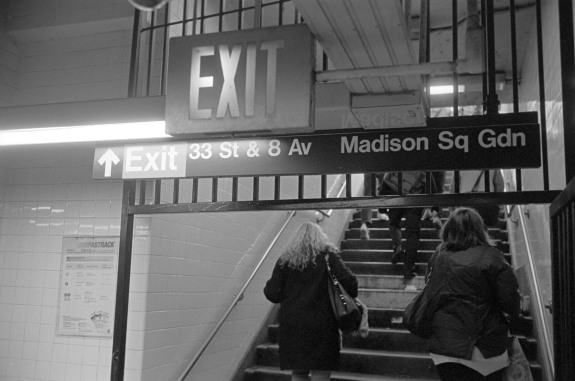
It’s a long walk to the Javits Center from the subway, so might as well make it a photo walk.

In the background is the James A. Farley Post Office Building, perhaps some day to be the new Penn Station. Back before we filed our income taxes electronically, this place would be very busy on the night of April 15 (when United States income tax is due) because they were open 24/7. You could squeeze in at the last minute by getting your envelope to the US Treasury postmarked on the correct day.
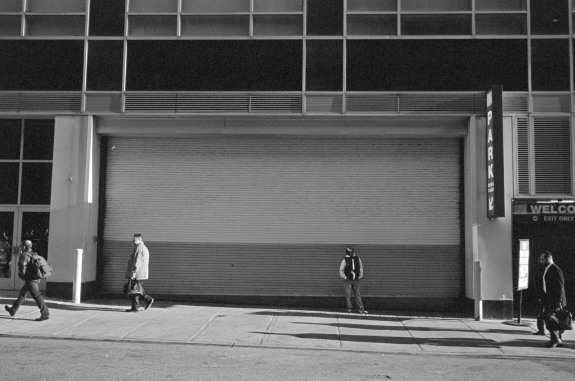
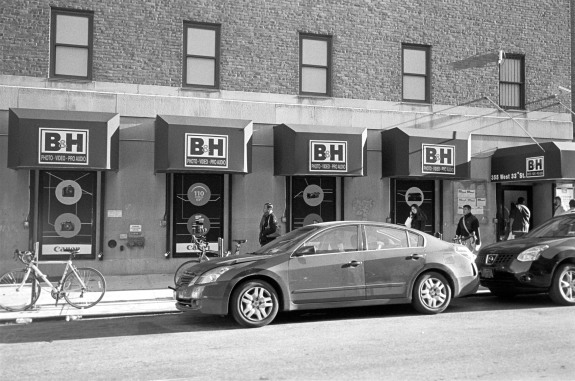
B&H is the largest photography retailer in the US, I think. They run shuttle buses between the convention center and their store. They have a comprehensive film and darkroom department, and they carry all the contemporary film cameras and lenses, e.g. by Cosina-Voigtlander. I usually prefer to order from Freestyle Photo, but B&H is just a subway ride away.

Jesus 2015, Leica M4, 35mm Summicron, Tri-X EI400, Rodinal 1:50 13 minutes
This guy’s in a plexiglass case to protect him from vandals. Apparently his hand has been in demand.

Same guy, ca. 2006. Canon L1, 50mm collapsible Summicron, EI1200, Diafine

First stop was Skylight Diner, which I only go to when attending PhotoPlus Expo. Nothing against the diner—the food’s quite good. It’s on the way to the convention center, and it’s full of people who are about to attend the convention. My photo of the diner was underexposed, so you get this photo instead.

New York City, and especially Manhattan and Brooklyn, is undergoing a massive building boom. You can’t look in any direction without seeing sidewalk sheds (scaffolding over sidewalks) and cranes. The McDonald’s in the bottom center of the frame is my desperate breakfast spot if I’m in a hurry on the way to the convention center. My job has had me at the Javits Center many times over the years.

Here’s another “photo walk,” but for this one they brought strobes. This is actually a workshop offered by the PhotoPlus Expo to learn a particularly complex and equipment-heavy form of street photography. Not in view: a shivering model.
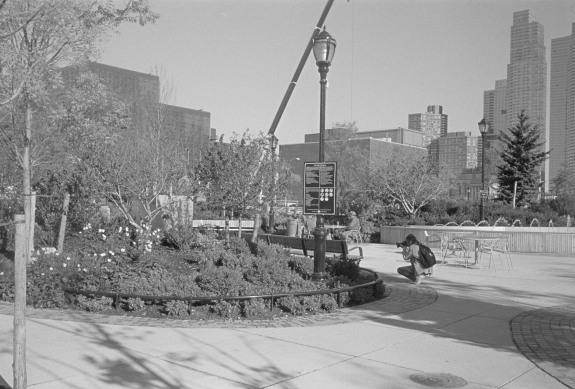
This is a typical photo in the half-mile radius around the Javits Center during PhotoPlus Expo. This gentleman is taking a photo of a bench. After this shot, he will check the LCD on the back of the camera. This is known as “chimping.” I “chimp” hours, days, weeks, and months (sometimes years) later.
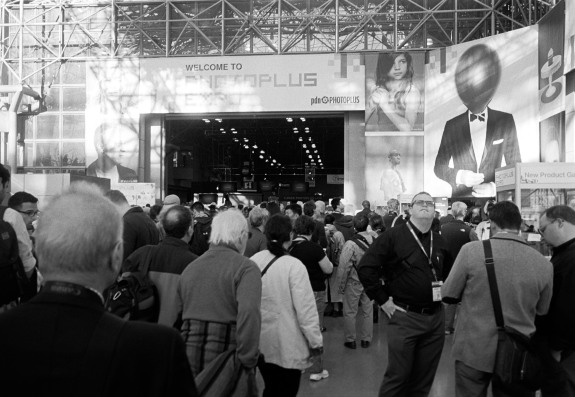
Holy cow. Here we are. It’s a mob scene. People cannot wait to see the drones.

Showing off big glass (compensating?) at the Canon booth.

Chrome Leica M-A
The Leica M-A is pretty much the original Leica MP, as far as I can tell. It has the M3 rewind knob and no meter. It costs a lot of money. It feels really nice, like an M3, M4, or MP. Just a note that the people at the Leica booth are very nice and will let you handle, shoot/play with anything. This isn’t a boutique—they are there to sell.

Leica was showcasing their new cinema lenses, which have huge lettering on them. SUMMICRON!
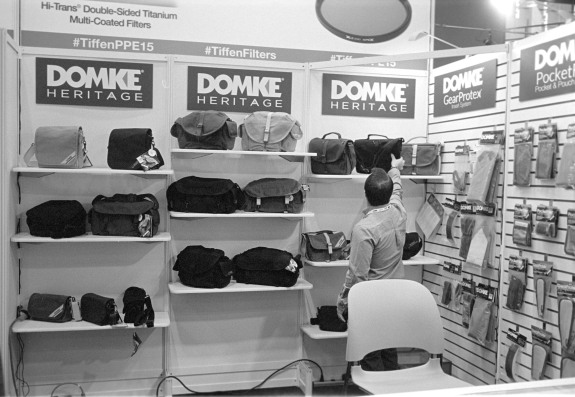
Domke. Made in Long Island, NY, USA. Absolutely wonderful bags. This year (by which I mean 2016), is Domke’s 30th anniversary, and they will be issuing some special bags for the occasion. Given that I already have a dozen of their bags (slight, but only slight, exaggeration), I don’t know if I’ll hop on that, but good to know for those of us who know how amazing, and affordable, these bags are.

Apparently this booth pays cash for your used gear, but maybe they also barter for this young woman’s knitting and other cute stuff? Note the tutu-wearing panda on the left. Off the (crochet) hook.
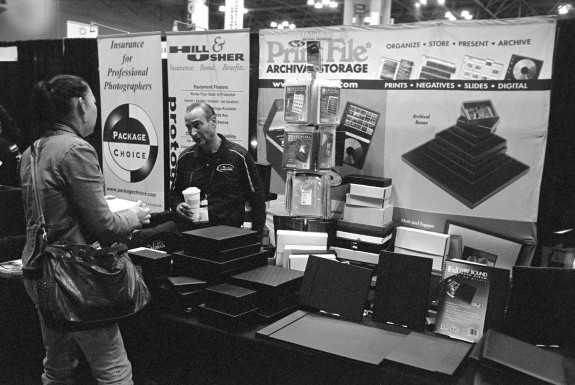
PrintFile are the standard for storage. I’m always happy to see them, even when they’re somewhat underexposed.

What do we call this phase of “aw, I miss film, so I’m going to do it kind of like film?” In years past, we had the fake Polaroid frame and the print-digital-to-instant-film. Today (and yesterday—to be fair, this isn’t new) we have services to make your digital file into a film negative and then print to fiber paper, optically. I guess it makes sense. Kind of like putting your digital music through a tube amp.
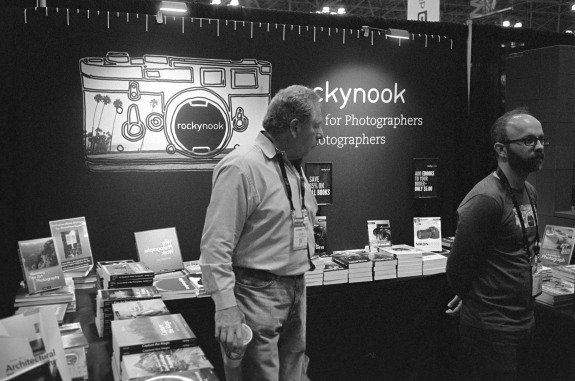
I’m not endorsing anything here, but I did note the M3 drawing as a backdrop. Good luck finding an M3 shooter using Skynook to publish his/her photos.

This is a great idea: Bokehfire is basically Netflix for lenses. You pay a monthly fee, and you get a lens. When you’re done with the lens, you can get a different lens. If they don’t have the lens you want, they will go out and buy it. When I talked to them, they just had the major DSLR lenses (i.e. not Leica M-mount), but if you shoot late-model Canon or Nikon film bodies, this is an affordable way to shoot some great glass, but only if you shoot with that body a lot.

Drone cameras. Seriously. They are all for drones.

Shooting large format-style with a small digital body.
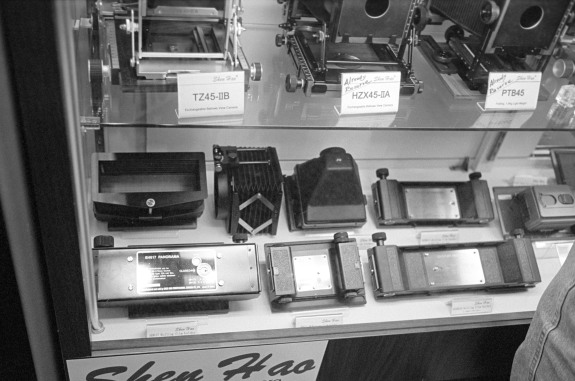
Shen Hao is for the deep-pocketed film nut. If they don’t have the crazy 120 panoramic back you’re looking for, they will build it for you.

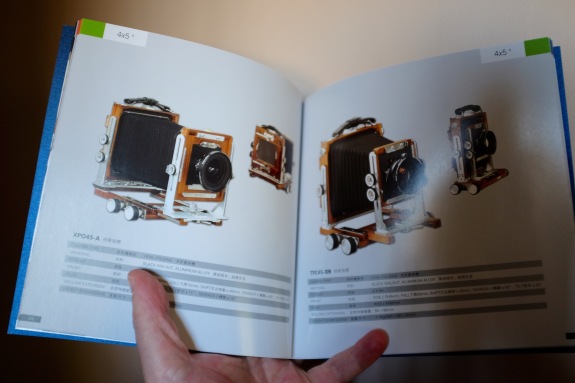
I need to make more time for large format photography. It’s very satisfying.

More drones.
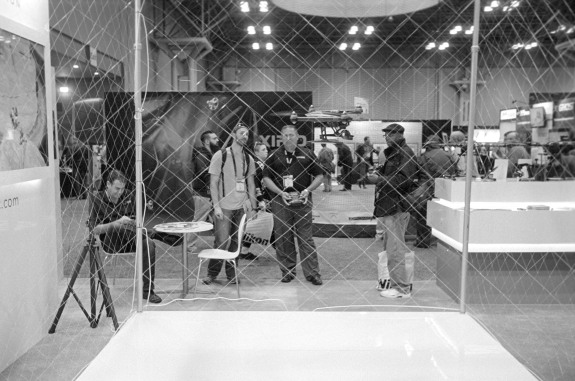
Oh yeah. These were everywhere. Drone “cages.” So we didn’t get messed up by drones while wind0w-shopping.
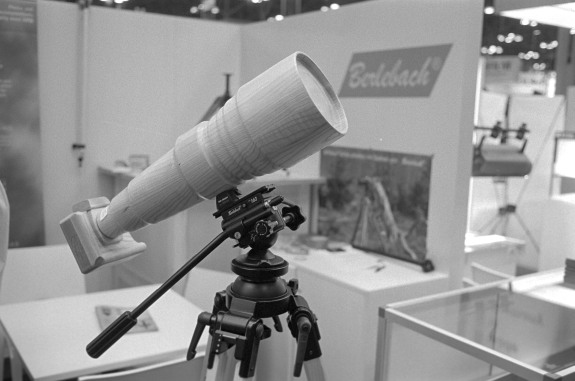
I liked this wooden camera/lens dummy so much, I bought one of their tripods. Just kidding. I didn’t buy the tripod because of the dummy. I bought it because they sold it to me for a great price. Exhibitors don’t want to haul everything back to wherever they came from, because that can be expensive. For example, these folks are based in Germany, so they were motivated to make a good cash deal on their excellent wood-legged tripod.
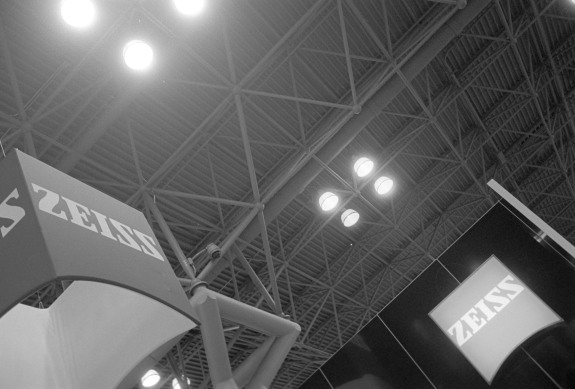
Zeiss was there, of course. They make lenses that fit on various film cameras. (Do you sense my desperation at finding stuff that’s film-related?)
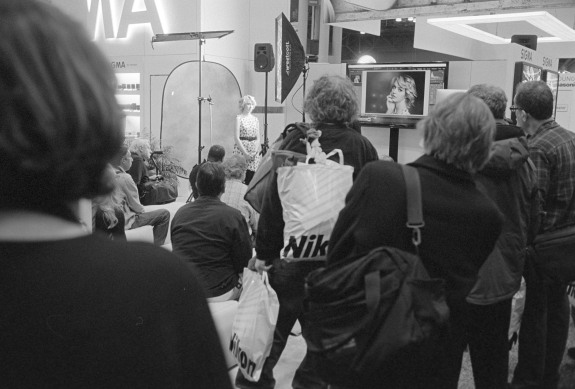
This is a terrible photograph, but in it you can see a model who’s being posed to demonstrate some Sigma equipment. PhotoPlus Expo is FULL of this—heavily made-up female models posing to demonstrate lighting equipment or lenses or workflow software, etc. And there are tons of men (rarely women) crowded around the models to shoot them as well. I could say a lot more about this topic, but not today.
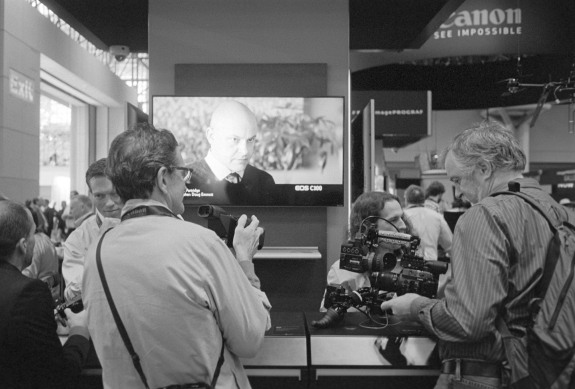
Rob Corddry: “Wait, what? When did they drop the EOS 1V?”
You can’t see it because I’m not a very good event photographer, but the guy on the left has a Leica slung over his shoulder. If I recall correctly, it was an M7 or M6.

Canon’s new lenses for 2015 all fit on my EOS 1V. And I will likely not purchase any of them. Did I ever tell you the story of my 50mm 1.0 and how a friend of mine dropped and broke it?

Here’s some cool Linhof stuff. It’s all being showcased with digital backs. No film. But it’s gorgeous.

Another drone.

FINALLY. Some FILM!
Of course it’s the Fujifilm booth.
I think Fujifilm gets the retro/cultish/cool thing about film. About instant film, that is.
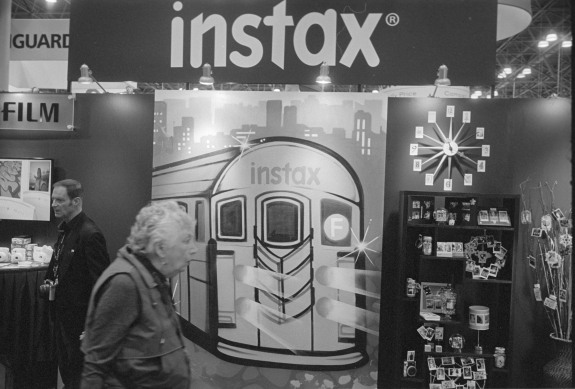
They built a set featuring the F train (6th Avenue local subway). Note all the other ideas for using your instant photos, on the right: make a clock, a potted tree, etc.

A potted tree, flowering with Instax prints
I think it’s a wonderful transition for people wrapped up in the immediate digital social-networking mode. You have to point, shoot, and wait. Maybe it’s a gateway drug to point, shoot, develop. And further to point, meter, focus, shoot, develop, contact print, print. Probably not for most people.
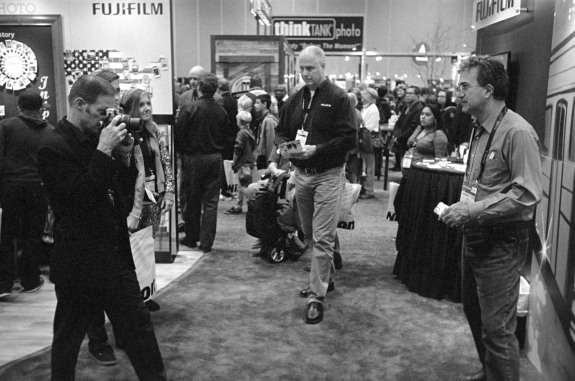
There was a line to get your Instax taken by this well-manicured gentleman.

Mr. Davidshootsfilm AKA Mr. Newyorkcamerastyle
He does good work.

And what’s this little egg the Fujifilm fairies have given to me?
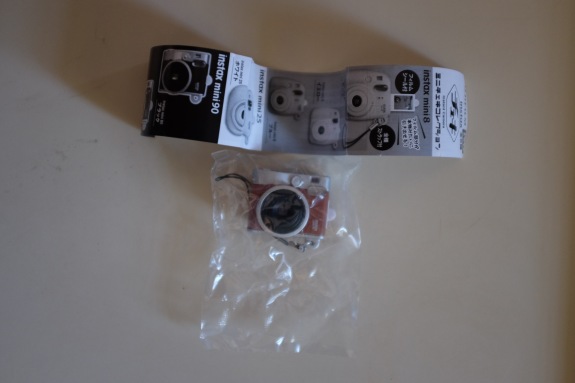
Adorbs! It’s an Instax camera fob! Hang it off your phone, or, hell, off your Instax! You can be cool and meta at the same time!

Kodak’s just a brand at this point. Who’s going to buy that Pixpro? Totally undifferentiated. Again, it’s just a brand. None of this is coming from the Rochester of olden times.

Think Tank makes awesome bags. If you’re packing a top-level DSLR and being sent overseas for an assignment, you may want to consider these. They’re obviously designed by working photographers and easy to customize. I’m a Domke guy, but I have a Think Tank backpack for traveling with my Canon EOS kit.

Hey, sexy beast. I’m talking to you, Polaroid Automatic 100. But, seriously, Mick Jagger’s still belting out his classics, and every Polaroid 100 Land Camera that wasn’t thrown in the trash still totally works OVER 50 YEARS LATER. Just like Mick. We expect this of Leicas and Canons and other brass-bodied beauties, but these Polaroids have electronics and bellows and hinges lots of other stuff that could go bad. But they (usually) don’t, because they were built to last.

This fellow is hawking his “film toaster” which is a box that allows you to insert your film negative and then take a photo of it with your DSLR so you can have a digital copy. It’s an interesting idea if 1) you only have a few strips of film to deal with or 2) you’ve never heard of a scanner. Scratch reason 1—it’s far too expensive if you only have a few strips of film.

This entire industry revolves around two things: taking photographs of women, and drones.

WANDRD was a Kickstarter project to make a bad-ass camera bag that also acts as a sort of table that you can hang off your shoulders to change lenses and other two-handed operations. If I were younger and wandering the globe taking photos, I would strongly consider getting one of these. In fact, I was entirely convinced at the show that I had to have this. Then I remembered that I take 90% of my photos with a Leica M and 35mm lens and I have no need for this whatsoever. But if you have more than one lens and a larger SLR, you should totally check this out. I’m not kidding—it’s really nice.

Lomography was showing off their Kickstarter-funded Instax cameras, among others. I keep trying to like the Lomo stuff, and I keep being disappointed. The Bel-Air 6×12 was crap, and the Lomo’Instant was a mixed bag. The film’s just too expensive to have to worry about whether it will come out—much like the early Impossible Project film. That said, I hope to post soon about the Lomo’Instant. What it does provide is more flexibility than the Fujifilm cameras via more manual control.

For the working professional like an event or wedding photographer, this show is probably a great resource. Even with a free expo floor pass, there are myriad lectures, workshops, and walkthroughs to help you be successful using the manufacturer’s tools and learn about their latest innovations. Trade show 101.

Speaking of innovations, Javits Center now offers wine glasses WITH LIDS. No more spilling your adult grape juice on that Canon Super Telephoto EF 600mm f/4 L IS II USM.
So that was the show. Kodak Alaris was absent (no free film) and you never see Ilford or anyone else at this show. If you’re shooting film, you’re not missing anything crucial if you skip the show. But the expo floor pass is free and it can be fun. If you like drones. And wine.
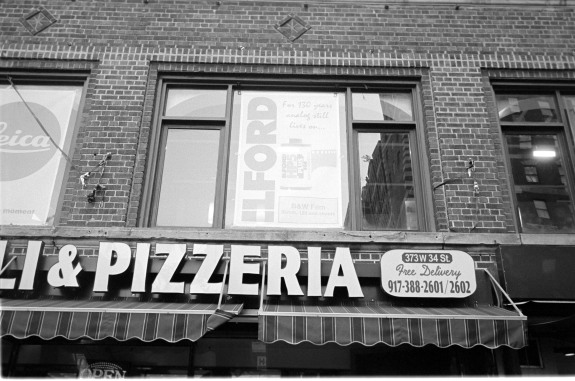
Finally – I found Ilford! PhotoVillage moved to a space across 34th from B&H several years ago. Above a pizzeria. Didn’t this used to be Chrysler Camera Repair?

Farther down the street, the B&H parking lot is full of Red Bull. Gotta keep that energy up for the expo!

And a block later, you get back to normal New York, where everyone’s like “PhotoWhat?”
Buy film. Shoot it. Develop it. Print it. Enjoy yourself.
News
Canon, convention, drones, film, film photography as a way of life, Fujifilm, Leica, News, PhotoPlus Expo, Polaroid, trade show, wine glass lids

















 David Shoots Film